Measure length
Measure from heel to tip along the cutting edge. A sheath range should cover the blade without forcing the tip.
Choose by knife brand, style, blade length, and series. ChefKnifeSheaths.com groups compatible sheaths into best fit, so you can buy with fewer guesses.
Waiting for a knife selection
Compare
Best Chef Knife Sheaths
ChefKnifeSheaths.com Buying Guide
Measure from heel to tip along the cutting edge. A sheath range should cover the blade without forcing the tip.
Tall German chef knives can fail in sheaths that fit slimmer Japanese knives of the same length.
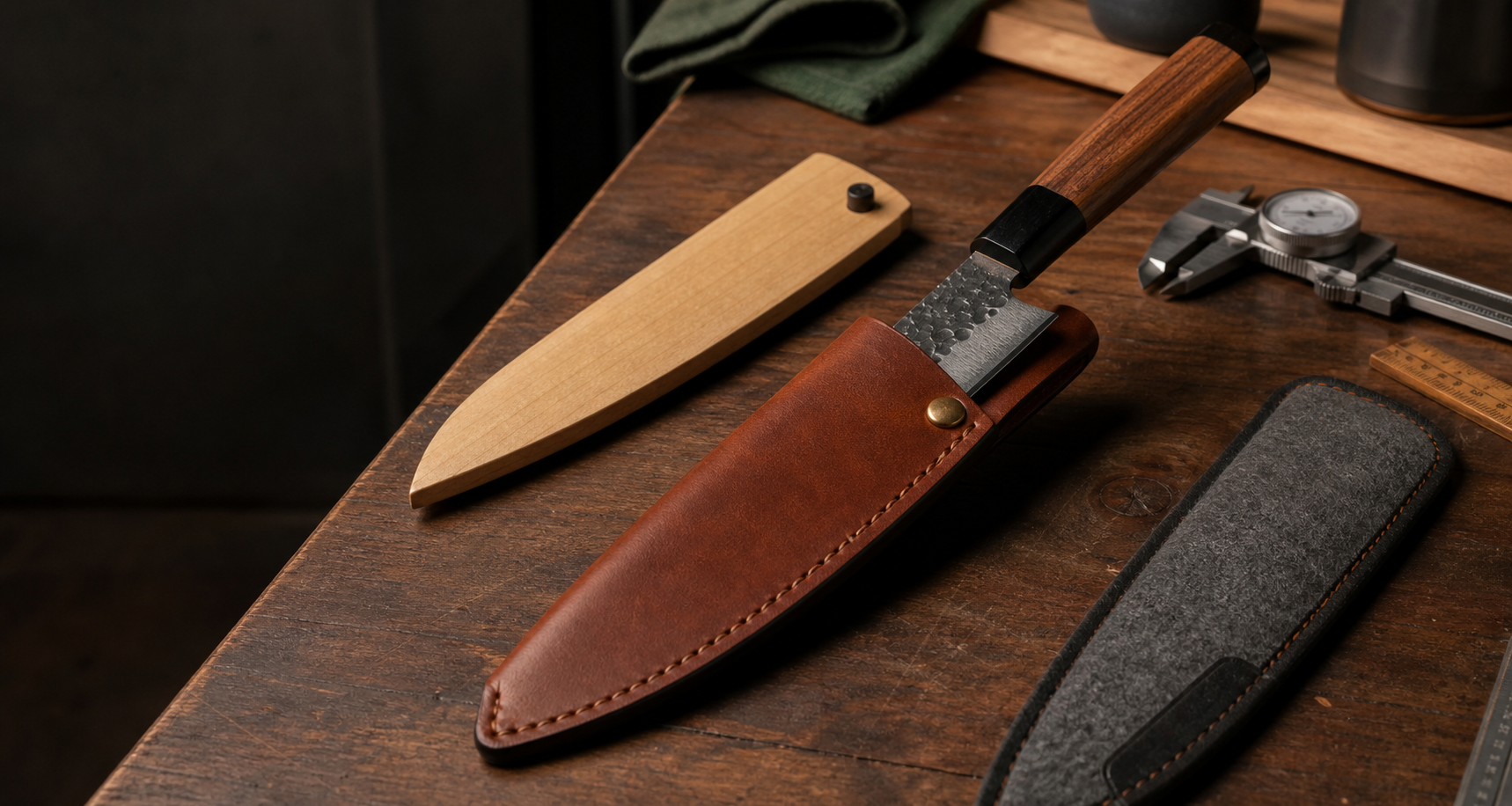
Leather is secure, sayas are precise, polymer guards are affordable, and soft guards are forgiving for travel kits.
Compare wooden sayas, leather, hard plastic, felt, and knife rolls — with pros, cons, and use-case guidance.
Contact ChefKnifeSheaths.com
Send sheath products, manufacturer specs, fit corrections, or relevant partnership inquiries.
Contact ChefKnifeSheaths.com
About ChefKnifeSheaths.com
ChefKnifeSheaths.com is built around a simple problem: most sheath listings describe the sheath, but not the exact knives it fits. This site starts with the knife record, then compares blade length, blade height, profile, material, and fit notes against sheath data.
The fit finder lets users choose a knife by brand, profile, blade length, and series. A matched knife record can then surface sheath options grouped by likely fit quality.
The database is curated and expanding. Some records use manufacturer specs, some use merchant data, and some still need measured confirmation before they should be treated as definitive.
Last updated: June 2026.
Methodology
Chef knife sheath fit is not only blade length. The site also considers blade height, profile/style, available clearance, retention style, and whether the match comes from an explicit fit record or dimension-based inference.
A tested, source-backed, or strong dimension match with usable clearance for the selected knife.
A likely match where height, length, profile, retention, or source quality deserves extra attention before buying.
A borderline match that should be verified against the merchant page or manufacturer before purchase.
Blade length and blade height are the most important dimensions. Records missing blade height are useful for discovery, but they should receive lower confidence until the missing data is filled in.
Fit recommendations are guidance, not a guarantee. Verify the current product listing before buying.
Editorial Policy
The site is designed to prioritize compatibility logic over affiliate placement. Product pages, fit notes, and recommendations should be traceable to specifications, direct product data, measured fit records, or clearly labeled editorial judgment.
Sheaths may be added from manufacturer pages, merchant listings, affiliate feeds, or direct product submissions. Inclusion does not mean every sheath is recommended for every knife.
Manufacturers, retailers, and users can submit corrections for dimensions, fit notes, photos, purchase links, or product availability through the contact form.
Editorial goal: make the fit reasoning visible enough that users can judge the recommendation.
Affiliate Disclosure
ChefKnifeSheaths.com may use affiliate links, including Amazon Associate links and merchant affiliate links. If a visitor buys through one of those links, the site may earn a commission at no extra cost to the visitor.
Affiliate status should not override fit logic. A sheath still needs compatible dimensions, useful notes, and a reasonable match for the selected knife.
Purchase buttons use language like Learn more and route to merchant pages. Amazon links are tagged with the site affiliate ID when applicable.
Privacy
ChefKnifeSheaths.com collects limited information needed to run the site, understand traffic, and respond to contact form submissions.
The site uses Google Analytics to understand aggregate traffic and site usage. Analytics helps identify which fit pages and tools are useful.
Contact form submissions may include name, email, company, product URL, and message text. These submissions are used to respond to product, correction, or partnership inquiries.
Do not send sensitive personal information through the contact form.
Buying Guide
There are five fundamentally different categories of chef knife sheath — and picking the wrong one before checking fit is how most people end up unsatisfied. The category determines how the sheath contacts the blade, how secure the fit is, and whether the sheath suits home storage, daily transport, or travel. Within each category, retention style determines how the sheath stays closed. Get the category right first, then choose retention.
A saya is a traditional Japanese wooden cover, most commonly made from magnolia (ho-no-ki). Magnolia is softer than steel, so the blade rests in the channel without edge contact or micro-scratches. The wood breathes, which matters for high-carbon steel that can rust in sealed environments.
Sayas are almost always knife-specific — sized to a particular model's blade length and height. That precision is the point: the fit is snug enough to hold without a strap, yet gentle enough not to mar a mirror polish.
Pros: Zero blade contact, breathable, precise, traditional aesthetic, excellent edge protection.
Cons: Expensive ($40–$150+), usually not universal, can crack or warp if submerged or stored wet, heavier knives may need a pin or retention strap.
Best for: A single high-end Japanese knife — gyuto, yanagiba, deba — stored at home or carried carefully to work.
Leather sheaths range from sewn Japanese-style cow-leather sayas to universal Western slip-on sleeves. Vegetable-tanned leather is the benchmark: it's stiff, durable, and molds slightly to the blade over time without off-gassing chemicals that could affect a carbon steel edge.
PU (synthetic) leather is a step down — it looks similar but doesn't break in the same way and can delaminate after a few years. Real leather at the $20–$60 range outperforms PU leather at any price for long-term use.
Pros: Durable, molds to blade, professional appearance, available in universal and knife-specific fits.
Cons: Can trap moisture against carbon steel if stored wet; needs occasional conditioning; universal sizing can be imprecise for tall blades.
Best for: Western chef knives and stainless Japanese knives in daily professional use. Avoid sealing a wet carbon steel blade in leather for extended storage.
Polypropylene, ABS, and polystyrene guards are the most common sheath type by volume. They come in two forms: slip-on sleeves (friction fit) and clamshell designs that hinge open and close with locking tabs or a magnetic closure. Both are inexpensive, washable, and widely available.
The tradeoff is edge contact. Hard plastic bears directly against the cutting edge, which can leave micro-scratches on mirror-polished blades over time. For a workhorse knife this is a non-issue. For a single-bevel or hand-polished Japanese blade, consider a saya or felt sleeve instead.
Pros: Inexpensive ($5–$25), washable, durable, widely available in universal sizes, clamshell designs survive rough handling.
Cons: Direct blade contact; loose universal fits rattle; clamshell tabs can fatigue and break with heavy daily use.
Best for: Workhorse knives, travel kits, knife block or drawer edge protection, budget-conscious buyers.
Felt, fleece, and fabric knife sleeves are the softest option — the blade rests in a channel with no rigid structure. That softness is the advantage: nothing scratches a mirror polish or leaves marks on a lacquered saya surface. Felt is also breathable, which makes it safe for carbon steel stored in a dry environment.
What felt cannot do is protect against impact. There is no rigidity between the edge and the outside world. A tip that catches a corner will push straight through. Felt is a storage solution, not a transport solution on its own.
Pros: Softest contact of any type, lightweight, breathable, inexpensive, won't scratch polished or delicate finishes.
Cons: No structural protection, tip can poke through, absorbs moisture if wet, not suitable as standalone protection for travel or transport.
Best for: Drawer or block storage of polished or carbon steel knives. Pair with a hard shell for travel.
A knife roll is a fabric or leather sleeve with individual pockets for multiple knives, rolled up and secured with a tie or strap. Canvas and waxed cotton rolls are common at the entry level; full-grain leather rolls are the professional standard. A good roll holds eight to twelve knives in dedicated slots, organized by size.
The key limitation is that a roll slot is not a rigid edge guard. The individual pockets keep knives separated and prevent cross-contact, but they don't absorb impact the way a plastic clamshell does. For knives with fine edges or mirror finishes, slip a plastic guard or felt sleeve on each knife before rolling. The roll organizes; the guard protects.
Pros: Carries a full kit in one compact package, keeps knives organized and separated, professional appearance, leather versions are durable for years of daily use.
Cons: Pockets are not rigid — pair with per-knife guards for edge protection; bulkier than a single sheath; overkill for one or two knives.
Best for: Culinary students, line cooks, private chefs, and anyone who travels between kitchens with a full kit of four or more knives.
Retention is how the sheath stays on or stays closed. It determines how quickly you can draw the knife and how secure it is in a bag or roll. The five common retention mechanisms span a range from frictionless one-hand draw to deliberate buckle-and-strap security.
The sheath channel is sized tightly enough to grip the blade without any mechanical closure. Draw speed is fast — one hand, no fumbling. Security depends entirely on how precisely the sheath was made for the knife. Found in most wooden sayas and many leather sheaths. Works well until wood warps or leather stretches.
Security: Medium | Draw speed: Fast
A strap crosses the spine or handle and snaps into a stud. More secure than friction — the knife won't slide out in a bag. Common on leather sheaths designed for field or travel use. One-hand draw is possible with practice, though slower than a bare friction fit.
Security: Medium-high | Draw speed: Medium
Plastic tabs on a clamshell guard click audibly into slots when the guard closes. The click confirms the knife is secured. Common on polypropylene clamshell guards. More positive than friction, fully tool-free to open, and the audible feedback is useful when sheathing by feel. Tabs can fatigue with years of heavy daily use.
Security: High | Draw speed: Medium
Magnets hold the two halves of a clamshell guard together. Fast to open and close with one hand, and the closure is self-aligning. The magnets used in kitchen knife guards are typically weaker ferrite magnets rather than rare-earth, and are considered safe for standard kitchen knives. For especially sensitive high-carbon Japanese blades, a friction or snap closure is the conservative choice.
Security: Medium | Draw speed: Fast
A leather strap threads through a buckle or D-ring to cinch the sheath closed. The most secure retention available — the knife will not move unless the buckle is deliberately released. Found on heavy-duty leather sheaths and large knife rolls. Draw speed is the slowest of any retention type, which is rarely a concern for kitchen storage but matters if the sheath doubles as a carry solution.
Security: Very high | Draw speed: Slow
Felt sleeves and some soft fabric guards have no closure at all — the sheath slips on and relies on gravity and the tightness of the sleeve to stay in place. Fine for drawer storage where the knife lies flat. Not suitable for transport or a bag where the knife might be jostled or inverted.
Security: Low | Draw speed: Very fast
A knife-specific wooden saya is the right answer. Friction fit, no edge contact, breathable. If your knife didn't come with one, most makers sell matching sayas or they're available from Japanese knife specialty retailers sized to common models.
Hard plastic clamshell guards on each knife, rolled in a knife roll. The rigid guards absorb impact in a bag; the roll keeps everything organized and separated. This combination covers most working-chef transport needs without the cost of individual sayas for every knife.
A leather sheath or universal hard plastic guard either works well. Leather is more durable and better looking over time. Plastic is easier to clean and replace. Both handle the blade height and length ranges common to German chef knives if you check the dimensions before buying.
Dry felt or fabric sleeves are the safest storage option — breathable, no trapped moisture, no scratch risk. Avoid sealing a damp carbon steel blade in leather or a closed plastic guard for extended periods. If you use leather, make sure the blade is completely dry before sheathing.
Blade height is the most common source of mismatch — a sheath sized for a slim Japanese gyuto (typically 42–48mm at the heel) often won't close over a tall German chef knife of the same blade length (50–58mm). Measure your blade at the tallest point, usually near the heel, before ordering any universal sheath.
For wooden sayas, fit is knife-specific — check the listed knife model, not just the blade length. For leather and plastic universals, manufacturers list a maximum blade height; treat that number seriously.
Use the fit finder to see sheath options matched to the dimensions of your specific knife.
Last updated: June 2026. Product availability and specifications change — verify current listings before purchasing.